
Best PLA Filament: How to Pick a Reliable Spool
Last reviewed
The strongest PLA spools publish a numeric diameter tolerance, a clear nozzle and bed temperature range and an exact net weight, on a reel that fits your printer or filament system. Choose the subtype (standard, PLA+, matte or silk) for the finish you want, then compare the current options by price per kg.
169 spools have an in-stock price verified in the last 24 hours on this list.
What a strong PLA spool tells you before you buy
A reliable spool is one you can set up from its label. The brands worth shortlisting publish the numbers that predict how the filament will behave: how far the strand diameter can drift, which nozzle and bed temperatures to start from, how much plastic is on the reel, and what the reel itself is made of. When a listing leaves those out, you find them out on your own printer, usually one failed first layer at a time.
Run through this checklist for every spool you consider in the grid below:
- Diameter tolerance as a number, such as ±0.02mm, rather than a vague "high precision" claim.
- A stated temperature range for both the nozzle and the bed.
- Spool material and dimensions, which decide whether the reel will turn freely in an AMS, CFS or ACE unit.
- Net weight of filament, stated separately from the shipping weight.
- Color range inside one line, so you can change color without changing your slicer profile.
- Sealed packaging with desiccant, so the filament arrives dry.
Current picks with verified prices
In-stock standard, PLA+, matte and silk spools whose specifications we have checked against the manufacturer.


SUNLU PLA Matte, Black White Grey Olive Green Red Blue Pink Orange Purple Clay
1.75mm · 1kg · 10 Pack
- Matte PLA
- 10 Pack
$92.58$102.87$9.26 per kg
Verified


SUNLU PLA+, Black White Grey Transparent
1.75mm · 1kg · 4 Pack
- PLA+
- 4 Pack
$37.35$52.99$9.34 per kg
Verified


ELEGOO PLA Plus, Black White Grey Space Grey
1.75mm · 1kg · 4 Pack
- PLA+
- 4 Pack
$38.69$45.99$9.67 per kg
Verified


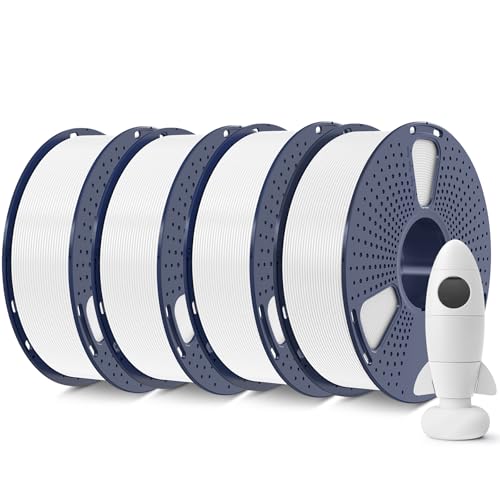

ELEGOO PLA Matte, Sakura Pink Lavender Purple Ice Blue Sunshine Yellow
1.75mm · 4kg
- Matte PLA
$39.99$45.08$10.00 per kg
Verified


Kingroon PLA, Black White Grey Red Blue Green Purple Skin Silver Yellow
1.75mm · 1kg · 10 Pack
- Standard PLA
- 10 Pack
$102.59$107.99$10.26 per kg
Verified

Comparison table
| Spool | Type | Net weight | Per kg | Price |
|---|---|---|---|---|
| JAYO PLA, Black | Standard PLA | 4.4kg (4 spools) | $8.18/kg | $35.99 |
| JAYO PLA, White | Standard PLA | 4.4kg (4 spools) | $8.42/kg | $37.04 |
| JAYO PLA+, Black | PLA+ | 4.4kg (4 spools) | $8.63/kg | $37.99 |
| JAYO PLA+, White | PLA+ | 4.4kg (4 spools) | $8.77/kg | $38.57 |
| Kingroon PLA, White | Standard PLA | 12kg (12 spools) | $9.15/kg | $109.79 |
| ELEGOO PLA Plus, Black | PLA+ | 4kg (4 spools) | $9.25/kg | $36.99 |
| SUNLU PLA Matte, Black White Grey Olive Green Red Blue Pink Orange Purple Clay | Matte PLA | 10kg (10 spools) | $9.26/kg | $92.58 |
| SUNLU PLA, White | Standard PLA | 4kg (4 spools) | $9.27/kg | $37.09 |
| SUNLU PLA+, Black White Grey Transparent | PLA+ | 4kg (4 spools) | $9.34/kg | $37.35 |
| SUNLU PLA+, Black | PLA+ | 4kg (4 spools) | $9.62/kg | $38.47 |
| ELEGOO PLA Plus, Black | PLA+ | 4kg | $9.66/kg | $38.66 |
| ELEGOO PLA Matte, Matte Black | Matte PLA | 4kg (4 spools) | $9.67/kg | $38.69 |
| ELEGOO PLA Plus, White | PLA+ | 4kg (4 spools) | $9.67/kg | $38.69 |
| ELEGOO PLA Plus, Black White Grey Space Grey | PLA+ | 4kg (4 spools) | $9.67/kg | $38.69 |
| Anycubic PLA+, Black | PLA+ | 4kg (4 spools) | $9.82/kg | $39.30 |
| ELEGOO PLA Matte, Matte White | Matte PLA | 4kg (4 spools) | $9.90/kg | $39.59 |
| SUNLU PLA Matte, White | Matte PLA | 4kg (4 spools) | $9.99/kg | $39.98 |
| ELEGOO PLA Matte, Sakura Pink Lavender Purple Ice Blue Sunshine Yellow | Matte PLA | 4kg | $10.00/kg | $39.99 |
| ELEGOO PLA, Black | Standard PLA | 4kg (4 spools) | $10.00/kg | $39.99 |
| ELEGOO PLA, Gray | Standard PLA | 4kg (4 spools) | $10.00/kg | $39.99 |
| SUNLU PLA Matte, Black | Matte PLA | 4kg (4 spools) | $10.00/kg | $39.99 |
| SUNLU PLA, Black | Standard PLA | 4kg (4 spools) | $10.00/kg | $39.99 |
| Kingroon PLA, Black White Grey Red Blue Green Purple Skin Silver Yellow | Standard PLA | 10kg (10 spools) | $10.26/kg | $102.59 |
| SUNLU PLA+, Grey | PLA+ | 4kg (4 spools) | $10.35/kg | $41.39 |
Related
Diameter tolerance: the figure that predicts consistency
Your slicer assumes the strand is exactly 1.75mm and meters plastic on that basis. Where the filament runs fat or thin, the printer pushes too much or too little for that stretch, which shows up as blobs, gaps or a rough top surface. A published tolerance is the manufacturer committing to how far the strand is allowed to wander.
| Brand and line | Published tolerance | Source |
|---|---|---|
| Prusament PLA | ±0.02mm | Prusament (opens in a new tab) |
| Overture PLA | ±0.02mm | Overture (opens in a new tab) |
| Anycubic PLA Basic | ±0.02mm | Anycubic (opens in a new tab) |
| ELEGOO PLA | ±0.02mm | ELEGOO (opens in a new tab) |
| eSUN PLA+ | ±0.03mm | eSUN (opens in a new tab) |
| Creality Hyper PLA | ±0.03mm | Creality (opens in a new tab) |
Both ±0.02mm and ±0.03mm are tight enough for everyday printing. The bigger signal is that a figure exists at all: a brand that publishes a number has measured it and gives you something concrete to hold the seller to.
Temperature range: wide means flexible, narrow means specific
Brands publish surprisingly different windows for the same base material. Polymaker lists 190 to 230°C on the nozzle and 25 to 60°C on the bed for PolyLite PLA (opens in a new tab). Prusament gives a tighter 200 to 220°C with a 40 to 60°C bed for its PLA (opens in a new tab). JAYO lists 200 to 210°C and a warmer 60 to 80°C bed for JAYO PLA (opens in a new tab). At the far end, Anycubic lists 190 to 260°C for PLA High Speed (opens in a new tab), a line it rates up to 600mm/s.
A wide window is not a sign of sloppiness. It usually reflects a range of print speeds, since plastic moving faster through the hot end needs more heat to melt in time. A narrow window gives you a precise starting point. In both cases, start near the middle and adjust in small steps; our PLA print temperature guide walks through that process.
Spool construction for AMS, CFS and ACE users
If you feed from a multi-spool unit, the reel matters as much as the plastic. Polymaker says all of its spools now have hardened edges that roll well in the AMS (opens in a new tab). ELEGOO notes that the AMS can rub the paper tray of a cardboard spool and cause it to delaminate, and describes adapting its spools for that (opens in a new tab). eSUN offers a printable adapter for its 1kg cardboard spool for AMS users (opens in a new tab).
Dimensions are the other half. Creality's CFS-C (opens in a new tab) accepts 1kg spools 197 to 202mm across and 42 to 68mm thick. Anycubic's ACE 2 Pro (opens in a new tab) lists a 195 to 200mm flange and 60 to 68mm width, and asks users to avoid cardboard spools. GEEETECH publishes its reel as 197mm outer, 59mm wide with a 74mm hub for its PLA (opens in a new tab): inside the CFS-C window, but 1mm narrower than the ACE 2 Pro's stated minimum width. That kind of check is only possible when a brand prints its spool size. We could not confirm Bambu Lab's AMS limits from Bambu's own site, so check Bambu's documentation before buying for an AMS.
Net weight and what is in the box
Net weight is the filament alone, without the reel. Most lines are 1kg, but not every brand: JAYO lists 1.1kg spools for both PLA (opens in a new tab) and PLA+ (opens in a new tab), and Prusament sells 1kg and 2kg sizes (opens in a new tab). pla.deals divides the offer price by the total net filament weight across every spool in the listing, so a 1.1kg reel is credited for the extra 100 grams instead of being compared as if it were 1kg.
Standard, PLA+, matte and silk: setting expectations
| Subtype | What to expect | A published example |
|---|---|---|
| Standard PLA | Easiest to print, crisp detail, rigid | Overture lists 190 to 220°C for Overture PLA (opens in a new tab) |
| PLA+ | Modified for toughness; the recipe varies by brand | eSUN lists 210 to 230°C for eSUN PLA+ (opens in a new tab) |
| Matte | Flat surface that hides layer lines | Overture lists a 50 to 70°C bed for Matte PLA (opens in a new tab), against 25 to 60°C for its standard PLA |
| Silk | Glossy, metallic sheen; often rated slower | Polymaker rates Panchroma Silk (opens in a new tab) up to 250mm/s, against 350mm/s for Panchroma Basic (opens in a new tab) |
Because PLA+ is not a standardized grade, treat each brand's version as its own material and read its settings. The PLA vs PLA+ guide covers the tradeoffs in more depth.
Matching a spool to your printer
- Speed. Compare the filament's rated speed with what you actually run. Creality lists 600mm/s for the K1 (opens in a new tab), while Prusament rates its PLA up to 200mm/s; on a fast machine, either slow your profile or choose a line sold for high speed. On the Ender-3 V3 SE (opens in a new tab), rated at 250mm/s, a standard line is a natural fit.
- Feeder fit. Check spool material and dimensions against your unit, as above.
- Diameter. Confirm 1.75mm. Some lines also come in 2.85mm, which will not feed a 1.75mm extruder.
- Profile availability. A line with consistent settings across many colors saves you retuning every time you switch.
The filament finder narrows the catalog by subtype, weight and price per kg.
How the grid on this page picks spools
There is no single winner here, because the right spool depends on your printer and finish. The grid ranks current listings using the criteria in how we rank. Each price carries the time it was checked against Amazon, and after 24 hours it falls back to "Check price at Amazon".
Frequently asked questions
Is PLA+ always stronger than standard PLA?
Not reliably. PLA+ is a marketing label for modified PLA, and each brand blends its own version. Some prioritize impact toughness, others layer adhesion. Compare the technical data sheets of the specific lines rather than assuming the plus sign means a fixed improvement.
Does ±0.02mm really beat ±0.03mm in practice?
On most hobby printers the difference is hard to see in finished parts. It matters more on fine detail work, small nozzles and very long prints. Treat any published figure as a good sign and an unpublished one as a reason to look closer.
Why do brands list different temperatures for the same material?
Each brand tunes its resin, pigment and additives differently and tests at different speeds. A line built for fast printing needs more heat, and a line with a short range is telling you where it was tuned. Use the brand's own numbers as your starting point.
Can I run cardboard spools in a multi-color feeder?
It depends on the unit. Anycubic asks ACE 2 Pro owners to avoid cardboard spools, while Creality says its CFS is not compatible with warped cardboard spools (opens in a new tab) but works with its own Hyper Series cardboard reels. Polymaker's hardened-edge reels and eSUN's printable adapter exist for exactly this reason.
Product prices and availability are accurate as of the date/time indicated and are subject to change. Any price and availability information displayed on Amazon at the time of purchase will apply to the purchase of this product.