
PLA Filament Price Per kg
Last reviewed
Price per kg is the listing price divided by the total net weight of filament in the listing, expressed in kilograms. It is the fairest way to compare PLA because it puts samples, single spools, large spools and multipacks on the same scale.
174 spools have an in-stock price verified in the last 24 hours on this list.
Current offers
Every in-stock 1.75mm spool and pack of 500g or more, sorted by price per kg. Samples are excluded from the ranking.


SUNLU PLA Matte, Black White Grey Olive Green Red Blue Pink Orange Purple Clay
1.75mm · 1kg · 10 Pack
- Matte PLA
- 10 Pack
$92.58$102.87$9.26 per kg
Verified


SUNLU PLA+, Black White Grey Transparent
1.75mm · 1kg · 4 Pack
- PLA+
- 4 Pack
$37.35$52.99$9.34 per kg
Verified


ELEGOO Rapid PLA Plus, Black
1.75mm · 1kg · 4 Pack
- High-speed PLA
- 4 Pack
$38.66$42.96$9.66 per kg
Verified


ELEGOO PLA Plus, Black White Grey Space Grey
1.75mm · 1kg · 4 Pack
- PLA+
- 4 Pack
$38.69$45.99$9.67 per kg
Verified


SUNLU High Speed PLA, Black White Red Orange
1.75mm · 4kg
- High-speed PLA
$39.42$41.50$9.86 per kg
Verified


SUNLU High Speed PLA, Black
1.75mm · 1kg · 4 Pack
- High-speed PLA
- 4 Pack
$39.70$41.79$9.93 per kg
Verified
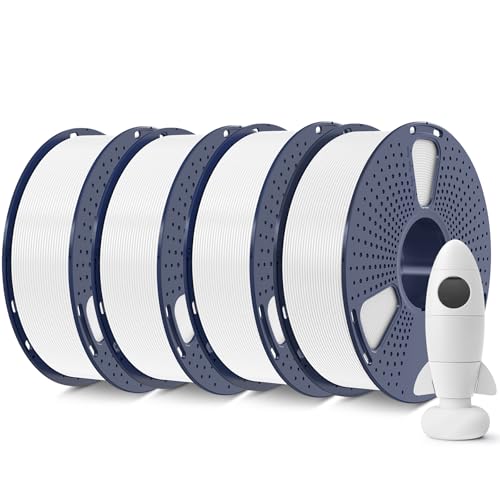

ELEGOO PLA Matte, Sakura Pink Lavender Purple Ice Blue Sunshine Yellow
1.75mm · 4kg
- Matte PLA
$39.99$45.08$10.00 per kg
Verified


Related
The formula
Price per kg = listing price ÷ total net filament weight in kilograms.
Two details make the formula work. "Total" means every spool in the listing, so a four-pack counts all four rolls. "Net" means the filament itself, not the spool, the box or the desiccant bag. Convert grams to kilograms by dividing by 1,000: 250g is 0.25kg, 1,100g is 1.1kg.
This is exactly how pla.deals fills the per kg column. Our system takes the offer price from Amazon and divides it by the net filament weight across all spools in that listing. No shipping, coupons or tax are folded in, because those vary by buyer.
Worked examples
The prices below are made up to show the arithmetic. They are not current offers.
| Listing | Net filament | Example price | Price per kg |
|---|---|---|---|
| Single 1kg spool | 1.0kg | $19.99 | $19.99 |
| Four 1kg spools in one box | 4.0kg | $52.00 | $13.00 |
| 250g sample spool | 0.25kg | $7.99 | $31.96 |
| One 3kg spool | 3.0kg | $45.00 | $15.00 |
| One 1.1kg spool | 1.1kg | $16.50 | $15.00 |
The single spool is the reference point. When net weight is exactly 1kg, price and price per kg are the same number, which is why so many people compare rolls by sticker price without noticing the habit breaks for anything else.
The four-pack shows why boxes need dividing. $52 looks expensive next to $19.99, but spread across 4kg it works out to $13.00 per kg, well under the single roll.
The sample runs the other way. A $7.99 price feels trivial, yet multiplying by four to reach a full kilogram gives $31.96. Spools of 250g or less are labelled samples on pla.deals and never compete in cheapest rankings for this reason.
The 3kg spool lands at $15.00 per kg. Big spools often save money per kilogram, but they only fit some holders, so check your printer before buying one.
The 1.1kg spool is the case people miss. JAYO lists a net weight of 1.1kg for its PLA (opens in a new tab), so a price that matches a competitor's 1kg roll actually buys 10% more filament. Dividing by 1.1 instead of 1 is the honest comparison.
Net weight versus spool weight
Filament boxes often print two weights. Net weight is the filament you can print. Gross weight adds the empty spool and sometimes the packaging. An empty plastic spool can be heavy enough to make a gross figure look generous, so always divide by net.
If a listing only gives one weight and does not say which, look at the item details and the label photo. Brand pages help here: SUNLU publishes the net weights it sells for its PLA line (opens in a new tab), from 250g through 500g, 1kg, 2kg, 3kg and 5kg. When the Amazon listing and the brand page disagree, trust neither until you know which is right, and lean toward the smaller figure in your math.
The same logic tells you how much is left on a roll you own. Weigh the spool, subtract the weight of an empty spool of the same type, and the remainder is the filament you still have.
How refills and cardboard spools change the math
Refills are coils of filament sold without a spool, meant to be mounted on a reusable hub. Because you are not paying for a new spool each time, refills can bring the per kg figure down, though you need the matching hub before the first one is useful.
Cardboard spools sit between the two: the flanges are paper board instead of plastic. Any packaging saving may or may not reach the shelf price. Several makers publish cardboard as the spool type for lines such as Polymaker PolyLite PLA (opens in a new tab) and eSUN PLA-Matte (opens in a new tab). The filament weight is what counts in the formula, so a cardboard spool and a plastic spool with the same net weight are compared directly.
The catch is compatibility, not math. A cheaper per kg figure on a cardboard spool is only a saving if your feeder or holder handles cardboard. Polymaker says its spools now have hardened edges for AMS use, while eSUN offers a printable adapter for its cardboard spools on its PLA+ page (opens in a new tab).
Reading the per kg column on pla.deals
On every filament card, the per kg figure appears next to the offer price. A few conventions keep it honest:
- The figure is computed from the price and total net weight, not taken from the seller.
- Each price shows when it was verified against Amazon. After 24 hours without a fresh check, the card shows "Check price at Amazon" instead of a number, and the per kg figure goes with it.
- Sample spools still show a per kg figure, so you can see what they really cost, but they do not enter cheapest rankings.
Sort the filament finder by price per kg to compare across brands, or browse the 5kg spools and multipacks where the per kg advantage of larger quantities is easiest to see.
Frequently asked questions
Does price per kg include shipping?
No. It uses the Amazon offer price only. Shipping, tax and coupons depend on your account and location, so add them yourself if they apply.
Why does a 1kg spool show a per kg figure equal to its price?
Because dividing any price by 1 leaves it unchanged. The column becomes useful when you compare that spool with packs, large rolls or odd sizes like 1.1kg.
How should I compare a refill with a spooled roll?
Divide each by its net filament weight as usual. Then add the one-time cost of a reusable hub to the refill if you do not already own one.
Is a lower price per kg always the better buy?
It is the better price for the filament. Whether it is the better buy also depends on whether the spool fits your printer, whether you will use that much before it absorbs moisture, and whether the color is right.
Product prices and availability are accurate as of the date/time indicated and are subject to change. Any price and availability information displayed on Amazon at the time of purchase will apply to the purchase of this product.