
Bulk PLA Filament: Multipacks, Large Spools and Refills
Last reviewed
Bulk PLA makes sense when you burn through one material or color steadily enough to finish it before it absorbs moisture, as print farms, classrooms and small product runs do. Choose between 1kg multipacks, 3kg to 5kg spools and refills based on what your feeder accepts and how much dry storage you have.
Right now the lowest verified price per kg on this list is $8.18/kg, for JAYO PLA in Black.
Current offers
In-stock listings with 2kg or more of PLA in total, multipacks and large spools, sorted by price per kg.


SUNLU PLA Matte, Black White Grey Olive Green Red Blue Pink Orange Purple Clay
1.75mm · 1kg · 10 Pack
- Matte PLA
- 10 Pack
$92.58$102.87$9.26 per kg
Verified


SUNLU PLA+, Black White Grey Transparent
1.75mm · 1kg · 4 Pack
- PLA+
- 4 Pack
$37.35$52.99$9.34 per kg
Verified


ELEGOO Rapid PLA Plus, Black
1.75mm · 1kg · 4 Pack
- High-speed PLA
- 4 Pack
$38.66$42.96$9.66 per kg
Verified


ELEGOO PLA Plus, Black White Grey Space Grey
1.75mm · 1kg · 4 Pack
- PLA+
- 4 Pack
$38.69$45.99$9.67 per kg
Verified


SUNLU High Speed PLA, Black White Red Orange
1.75mm · 4kg
- High-speed PLA
$39.42$41.50$9.86 per kg
Verified


SUNLU High Speed PLA, Black
1.75mm · 1kg · 4 Pack
- High-speed PLA
- 4 Pack
$39.70$41.79$9.93 per kg
Verified
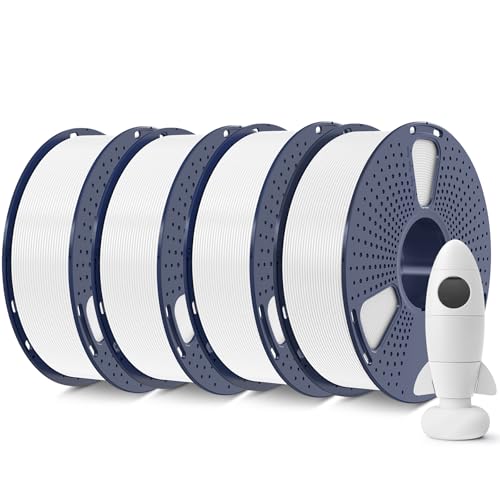

ELEGOO PLA Matte, Sakura Pink Lavender Purple Ice Blue Sunshine Yellow
1.75mm · 4kg
- Matte PLA
$39.99$45.08$10.00 per kg
Verified


Related
Who gets real value from bulk PLA
Buying filament by the case only saves money if the filament gets used while it is still in good shape. That favors a few kinds of buyer:
- Print farms running several machines on the same black, white or gray every day.
- Schools and makerspaces, where dozens of students print small parts on shared printers and a teacher wants one profile that always works.
- Small product sellers printing the same item, in the same color, week after week.
- One-color hobbyists who print mostly functional parts and rarely change color.
Bulk is a poor fit if you print a few hours a week, like experimenting with new colors, or have not settled on a brand yet. In that case a single spool from a line you already trust, or a short multipack, is a smaller commitment with far less risk of stock going stale.
Three ways to buy PLA in volume
| Format | What you get | Strengths | Watch out for |
|---|---|---|---|
| Multipack of 1kg spools | Several standard reels in one box | Each reel fits standard holders and most feeders; colors can differ | More empty reels to dispose of |
| Large spool (3kg or 5kg) | One heavy reel | Fewer spool changes on long single-color jobs | Too big for most multi-spool feeders; needs a sturdy holder |
| Refill coil | Filament wound without a reel | Less packaging; reuses a spool you already own | Needs a compatible reusable spool and careful handling to avoid tangles |
Large spools are a manufacturer offering, not just a reseller bundle. Polymaker lists PolyLite PLA (opens in a new tab) in 1kg, 3kg and 5kg net weights, and eSUN does the same for eSUN PLA+ (opens in a new tab). Prusament offers a 2kg size (opens in a new tab) alongside 1kg, which can suit someone who wants fewer changes without moving to a heavy reel.
Feeder limits rule out most large spools
If your printer draws filament from a multi-spool unit, the unit's published spool limits decide which bulk formats you can use there.
| Feeder | Spool diameter | Spool width | Weight or size | Cardboard | Source |
|---|---|---|---|---|---|
| Creality CFS | 197 to 202mm | up to 68mm | 1kg spool | Supported if not warped and edges are treated | Creality CFS manual (opens in a new tab) |
| Creality CFS-C (K1 series) | 197 to 202mm | 42 to 68mm | 1kg spool | Not stated | Creality (opens in a new tab) |
| Anycubic ACE 2 Pro | 195 to 200mm flange | 60 to 68mm | Not stated | Avoid | Anycubic (opens in a new tab) |
The practical result: 3kg and 5kg reels do not belong in these units, so they run from an external holder and feed directly. Anycubic's page for the original ACE Pro leaves its spool compatibility field blank, and we could not verify Bambu Lab's AMS limits from Bambu's own site, so look up those units in the manufacturer's documentation before ordering a big reel. If you print multicolor work from a feeder, a multipack of 1kg spools is usually the bulk format that actually fits.
Dry storage is part of the bulk price
PLA picks up moisture from the air once the bag is opened. Damp filament tends to string, pop and leave a rough surface, and the longer a spool sits open, the more it matters. A single 1kg spool might be finished in a couple of weeks; the last reel of a big lot could sit for months. Several brands flag this directly: Anycubic recommends drying its PLA+ (opens in a new tab) before use, and eSUN flags drying for eSUN PLA+ (opens in a new tab).
Plan the storage before the order arrives:
- Leave spools sealed in the factory bag until the day you load them.
- Open one reel per printer at a time, rather than unwrapping the whole box to sort colors.
- Reseal partial spools in vacuum bags or zip bags with fresh desiccant between jobs.
- Use a dry box for spools in active rotation, especially in humid rooms or garages.
- Rotate stock first in, first out, and write the opening date on each reel.
Desiccant, bags and a dry box or dryer cost money, and that spend belongs in your comparison. A lot that looks cheaper per kg can lose its edge once you add storage gear you did not already own, or once a few spools need drying before they print cleanly.
Five questions before ordering a bulk lot
- How many grams do you use per month? Check your slicer's filament totals for recent jobs.
- How many months will the lot last? Divide total net grams by monthly use. If the answer is longer than you can keep it dry, buy smaller.
- Does the format fit your hardware? Large reels need an external holder; feeders need spools inside their published limits.
- Will you use every color? Spools you never load are not a saving.
- Is it one material? Make sure the lot is PLA throughout, not a mix with PETG or other plastics.
How pla.deals lists bulk offers
Every bulk listing is reduced to one comparable figure: the offer price divided by the total net filament weight across all spools in the box. Reels of 250g or less are labelled samples and kept out of cheapest rankings. The price per kg page explains the method, and the cheapest PLA list sorts the full catalog by it.
Frequently asked questions
Does sealed PLA go bad in storage?
Sealed filament with desiccant keeps far better than an open reel, which is why bulk buyers should open spools only as needed. Once opened, PLA slowly absorbs moisture. It can usually be dried and used again, but that takes time and equipment.
Can a 3kg or 5kg spool go in a filament feeder?
Not in the units whose limits we could verify. Creality's CFS and CFS-C list 1kg spools, and Anycubic's ACE 2 Pro lists a 195 to 200mm flange. Large reels run from a separate holder that feeds the printer directly.
Is bulk always cheaper per kg than single spools?
No. A single spool on promotion can match or beat a bulk lot. Compare the per kg figure for the specific line and color rather than assuming the bigger box wins.
How many colors should a bulk order cover?
Only the colors you load every week. Neutrals such as black, white and gray are the obvious candidates; accent colors can be bought as single spools when a project calls for them.
Product prices and availability are accurate as of the date/time indicated and are subject to change. Any price and availability information displayed on Amazon at the time of purchase will apply to the purchase of this product.