
10kg PLA Filament: Bundles, Spools and the Per kg Math
Last reviewed
A 10kg PLA bundle is usually ten 1kg spools in one box, and its true cost is the listing price divided by the total net filament weight of every spool. How long it lasts depends entirely on what you print, so divide 10,000 grams by your typical part weight, including purge and failed prints, to estimate it.
Right now the lowest verified price per kg on this list is $9.15/kg, for Kingroon PLA in White.
Current offers
In-stock listings with 10kg or more of PLA in total, sorted by price per kg.

SUNLU PLA Matte, Black White Grey Olive Green Red Blue Pink Orange Purple Clay
1.75mm · 1kg · 10 Pack
- Matte PLA
- 10 Pack
$92.58$102.87$9.26 per kg
Verified

Kingroon PLA, Black White Grey Red Blue Green Purple Skin Silver Yellow
1.75mm · 1kg · 10 Pack
- Standard PLA
- 10 Pack
$102.59$107.99$10.26 per kg
Verified


Kingroon PLA, Black White Grey Red Blue Green Pink Yellow Orange Purple Silver Skin
1.75mm · 1kg · 12 Pack
- Standard PLA
- 12 Pack
$126.34$132.99$10.53 per kg
Verified

ELEGOO PLA Plus, Black White Grey Red Yellow Orange Dark Blue Neon Green Pink Purple
1.75mm · 10kg
- PLA+
$116.99$129.99$11.70 per kg
Verified


SUNLU High Speed PLA, Black White Grey Pink Red Orange Yellow Green Blue Lavender Purple
1.75mm · 1kg · 10 Pack
- High-speed PLA
- 10 Pack
$120.02$126.34$12.00 per kg
Verified

SUNLU PLA, Black White Grey Red Blue Green Yellow Orange Lavender Purple Clear
1.75mm · 1kg · 10 Pack
- Standard PLA
- 10 Pack
$122.73$129.19$12.27 per kg
Verified


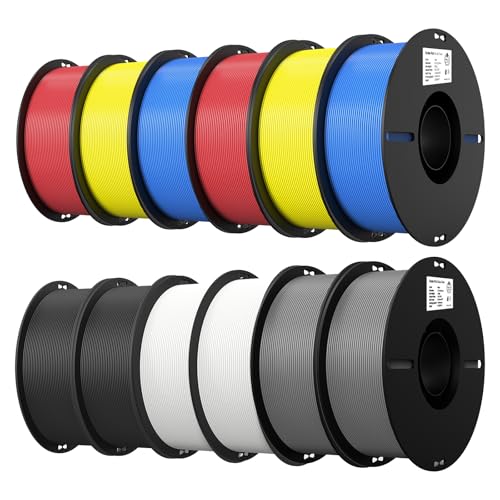
Creality PLA, Black White Grey Blue Red Yellow
1.75mm · 1kg · 12 Pack
- Standard PLA
- 12 Pack
$117.31$123.49
Verified


SUNLU PLA+ 2.0, Black White Grey Blue Red Yellow Olive Green Orange Purple Wood
1.75mm · 1kg · 10 Pack
- PLA+
- 10 Pack
$123.11$136.79
Verified

SUNLU PLA+ 2.0, Black White Grey Red Klein Blue Green Yellow Sunny Orange Lavender Purple Beige
1.75mm · 1kg · 10 Pack
- PLA+
- 10 Pack
$123.11$136.79
Verified


Anycubic Transparent PLA, Black White Texture Grey Clear Red Blue Green Orange Yellow Purple
1.75mm · 10kg
- Transparent PLA
$139.99
Verified
Related
How 10kg bundles are usually packed
Most listings sold as 10kg contain ten standard 1kg spools, each in its own sealed bag. That layout is the easiest to live with: every reel fits an ordinary spool holder, you open them one at a time, and a 1kg reel goes into a multi-spool feeder if your printer has one.
Other combinations appear too, so read the contents line rather than the headline:
- Two 5kg reels. Some manufacturers sell 5kg spools on their own, including Polymaker for PolyLite PLA (opens in a new tab) and eSUN for eSUN PLA+ (opens in a new tab). A pair of them adds up to 10kg but needs a heavy-duty holder.
- Spools that are not exactly 1kg. JAYO lists its standard spool as 1.1kg for JAYO PLA (opens in a new tab). Ten reels of that size would carry 11kg of filament, so the spool count alone does not tell you the total.
- "10 rolls" or "10 pack" without a weight. Ten rolls could be ten 1kg spools or ten small reels. If the per spool net weight is missing, you cannot judge the offer.
- Accessory bundles. A search for 10kg filament can also surface ten-piece tool or storage kits. Check that the product is filament, not a set of parts sold alongside it.
Working out the per kg cost of a 10kg listing
The formula is the same one pla.deals applies to every listing: offer price divided by total net filament weight across all spools. With a hypothetical bundle of ten 1kg spools listed at $150, that is 150 ÷ 10 = $15.00 per kg. If the same $150 bought ten 1.1kg spools, the divisor becomes 11 and the figure drops to about $13.64 per kg.
Two details change the result:
- Net, not gross. Shipping weight includes the reels, bags and box. Only the filament counts.
- Every spool counts. If a listing mixes 1kg reels with a couple of small bonus spools, add all of their net weights together before dividing.
Reels of 250g or less are labelled samples on pla.deals and are never ranked in cheapest lists, so a box of small spools will not appear alongside true 10kg bundles. Listed prices show when they were last checked against Amazon. The price per kg page goes through the method step by step.
Single color or a color mix?
A 10kg box in one color suits production work: a farm printing the same black enclosure, a club printing gray brackets, or a seller whose product only comes in white. Every spool behaves the same, and a single slicer profile covers the lot.
A mixed-color 10kg box suits classrooms and families, where variety matters more than matching. The tradeoff is that you commit to the seller's color choices. If you only load four of the ten colors regularly, the other six sit opened or unopened for months. A fair way to judge a mixed bundle is to count only the colors you expect to use and divide the price by that weight instead. If the result is worse than buying those colors as single spools, the bundle is not a saving for you.
Mixed bundles sometimes combine finishes too, such as standard, silk and matte. Those can need different settings. Polymaker, for example, rates Panchroma Silk (opens in a new tab) up to 250mm/s against 350mm/s for its basic PLA (opens in a new tab), so a mixed box may mean switching profiles between reels.
How long does 10kg last? Do the arithmetic
There is no honest average for how long 10kg lasts, because it depends entirely on what you print. You can estimate it in two minutes with numbers from your own slicer.
Step 1: part weight. Slice a typical job and note the filament weight in grams the slicer reports. Use the total including supports, brim and any purge.
Step 2: parts per bundle. Divide 10,000 grams by that weight.
| Typical part weight | Parts from 10,000g |
|---|---|
| 20g | 500 |
| 50g | 200 |
| 120g | about 83 |
| 400g | 25 |
Step 3: allow for waste. Failed prints, test pieces and calibration cubes all use filament. If you know roughly what share of your prints fail, reduce the count by that share. Multicolor printing through a feeder also purges filament at every color change, and the slicer includes this in its estimate, so slice with your real color setup.
Step 4: turn it into time. Divide 10,000 grams by the grams you print per week. A printer using 500g a week finishes the box in 20 weeks; one using 2,000g a week finishes it in five.
That last number is the one to compare against your storage. If the box will take half a year to use, plan how you will keep the last spools dry.
Keeping ten spools in printable condition
- Store the unopened bags somewhere cool, dark and away from humid rooms.
- Open the next spool only when the current one is nearly finished.
- Return a half-used reel to a bag with desiccant whenever it comes off the printer.
- Mark each reel with the date you opened it, so the oldest gets used first.
For broader advice on volume purchases, including feeder limits for large reels, see the bulk PLA guide. If 10kg feels like too much commitment, a 5kg option halves both the spend and the storage.
Frequently asked questions
Is a 10kg bundle always cheaper per kg than buying 1kg spools?
Often, but not always. Single spools on sale can come close to or beat a bundle. Compare per kg figures for the same line rather than assuming the larger box is the better deal.
Will all ten spools of the same color match exactly?
Listings rarely promise that every spool comes from one production batch. If perfect color matching across a large print matters, use a single spool for the visible parts or ask the seller about batch numbers before relying on it.
Can I load a 10kg bundle into a multi-color feeder?
If it is ten 1kg spools that meet your feeder's size limits, yes, one reel per slot. A 10kg bundle made of two 5kg reels will not fit units such as Creality's CFS-C (opens in a new tab), which lists 1kg spools.
What should I do with ten empty reels?
Plastic reels can be reused for refill coils if the design allows it, or recycled where accepted. Cardboard reels are easier to recycle in most areas. Factor the waste into your choice if it matters to you.
Product prices and availability are accurate as of the date/time indicated and are subject to change. Any price and availability information displayed on Amazon at the time of purchase will apply to the purchase of this product.