
SUNLU PLA Matte, Black White Grey Olive Green Red Blue Pink Orange Purple Clay
1.75mm · 1kg · 10 Pack
- Matte PLA
- 10 Pack
$92.58$102.87$9.26 per kg
Verified
Last reviewed
Matte PLA is PLA with additives that give printed surfaces a flat, low-sheen look that hides layer lines, and makers often publish slightly different bed temperatures and speed ratings for it than for their glossy lines. A strong matte spool states its own temperature window, speed rating and spool type, so compare those against your printer before sorting by price per kg.
83 spools have an in-stock price verified in the last 24 hours on this list.
Glossy PLA reflects light off each layer, so every ridge catches the eye. Matte PLA carries additives that scatter light at the surface, and the result reads as a soft, almost chalky finish where individual layers are much harder to pick out. That makes it a common choice for display models, architectural pieces, cosplay props and anything you plan to photograph, because the print looks less like plastic and more like a cast or molded object.
The tradeoff is that the additives change the material. Makers rarely say exactly what they add, but their spec sheets show the effects: different bed temperatures, different speed ratings and, in at least one case, a note about wear on the nozzle.
In-stock matte PLA spools with a price verified in the last 24 hours, spools with checked specifications first.
1.75mm · 1kg · 10 Pack
$92.58$102.87$9.26 per kg
Verified


1.75mm · 4kg
$39.99$45.08$10.00 per kg
Verified


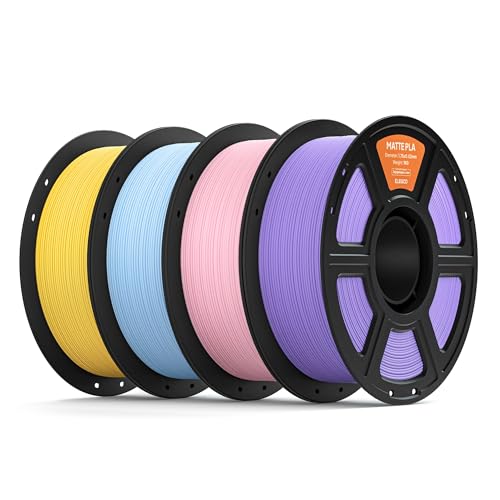
1.75mm · 1kg · 4 Pack
$43.99$51.99$11.00 per kg
Verified


The cleanest way to see what a matte formula changes is to read it next to the maker's glossy line.
| Brand | Standard PLA | Matte PLA |
|---|---|---|
| Overture | Bed 25 to 60°C, 190 to 220°C nozzle (PLA (opens in a new tab)) | Bed 50 to 70°C, 190 to 230°C nozzle (Matte PLA (opens in a new tab)) |
| SUNLU | 200 to 240°C, rated 200mm/s (PLA (opens in a new tab)) | 205 to 245°C, rated 230mm/s (PLA Matte (opens in a new tab)) |
| Polymaker | Panchroma Basic rated 350mm/s (Basic (opens in a new tab)) | Panchroma Matte rated 300mm/s (Matte (opens in a new tab)) |
Overture's matte line wants a noticeably warmer bed, with a floor of 50°C instead of 25°C. SUNLU nudges both ends of the nozzle window up five degrees and rates the matte version slightly faster than its standard PLA. Polymaker goes the other way on speed, rating Panchroma Matte below Panchroma Basic. There is no single direction a matte formula pushes the numbers, which is why each line needs its own profile.
Other makers publish matte figures without a side-by-side baseline. eSUN lists 190 to 230°C on the nozzle, 45 to 60°C on the bed and up to 200mm/s for PLA-Matte (opens in a new tab), on a cardboard spool. ELEGOO states ±0.02mm tolerance for PLA Matte (opens in a new tab), also on cardboard.
Polymaker describes Panchroma Matte as slightly more abrasive than regular PLA (opens in a new tab) and suggests a hardened nozzle may be worth considering for heavy use. That is an unusually candid statement, and it is the only matte-specific abrasion note in our research files; other makers do not mention it either way.
In practice, that matters most if you print a lot of matte on a soft nozzle. Creality's K1 and Ender-3 V3 ship with hardened steel nozzles (opens in a new tab), while the Ender-3 V3 SE ships with brass (opens in a new tab). Matte PLA is not grouped with carbon fiber or glow fills, which this site's compatibility notes mark as not recommended on brass or stainless nozzles, but a nozzle you plan to run matte through for hundreds of hours is a consumable worth watching.
When you compare listings, remember that pla.deals works out price per kg from the total net filament weight in the listing, so a 3kg Panchroma Matte pack and a single 1kg spool sit on the same scale.
Bed temperature. A 50 to 70°C matte bed range is easy for most machines, but if your printer runs PLA at 35°C on a textured plate by default, raise it for lines like Overture's. Our print temperature guide covers nozzle and bed adjustment in small steps.
Feeders. Cardboard matte reels in an AMS or CFS benefit from the maker's adapter or a hardened-edge reel. The AMS filament page lists what to check.
Mixing finishes. In a multi-color print, matte beside silk or standard PLA shows a clear change in sheen at the boundary. That can be a deliberate design choice, but it surprises people who expected one uniform surface.
For a broader view of finishes, the best PLA filament page puts matte next to standard, PLA+ and silk. The filament finder can filter to matte only.
Makers rarely publish a direct comparison. Polymaker's matte page, for example, does not compare strength with its glossy lines. If a part is structural, look for a technical data sheet with mechanical figures for that exact line rather than assuming either way.
Not usually for occasional use. Polymaker says its matte formula is slightly more abrasive than regular PLA and suggests a hardened nozzle may be worth considering for heavy use. If you print mostly matte on a brass nozzle, check the nozzle for wear periodically.
Gloss differences often come from speed or temperature changes across a print, such as slower small layers or a hotter first layer. Keep speeds consistent and stay within the maker's stated nozzle range.
Yes, subject to the reel. Several matte lines ship on cardboard, so use a hardened-edge reel, the maker's adapter ring, or respool onto plastic if your unit does not handle cardboard well.
Product prices and availability are accurate as of the date/time indicated and are subject to change. Any price and availability information displayed on Amazon at the time of purchase will apply to the purchase of this product.